
Global Atmosphere and Ocean Temperatures Hovered Near Record Levels in May
Global temperatures remained at near-record levels in May, extending a prolonged streak of extreme planetary warmth. Recent months have shown consistently elevated readings, with December, January, and February each ranking as the fifth-warmest for their respective months. March became the fourth-warmest March on record globally, while April ranked as the third-warmest April ever recorded.
Extreme heatwave in Western Europe
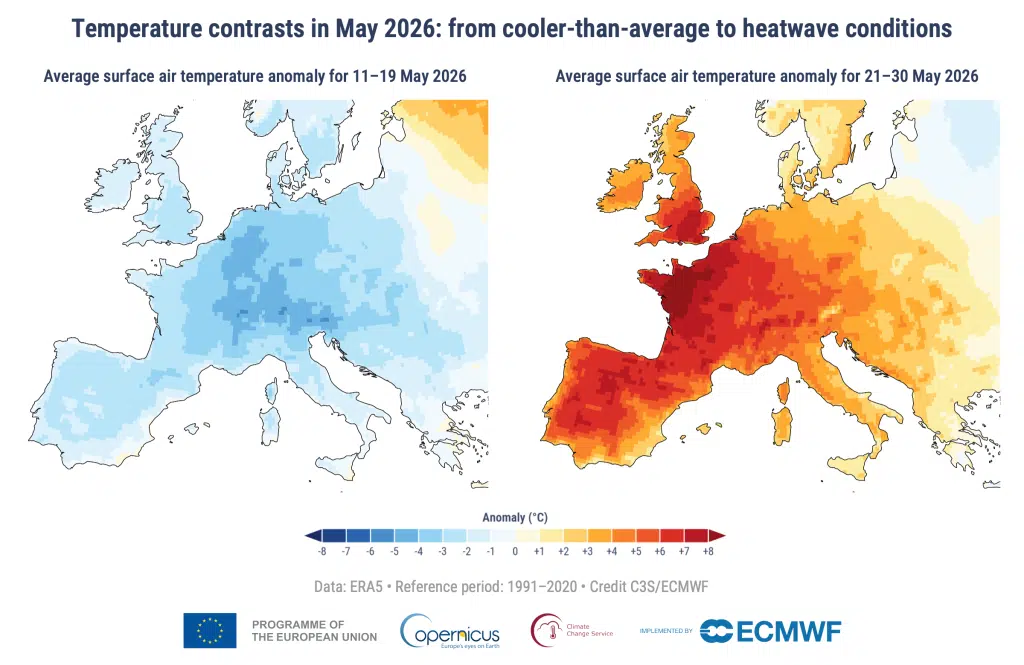
An exceptionally strong heatwave affected much of Western Europe in the second half of May, following a brief period of cooler-than-average conditions earlier in the month.
According to the forecaster’s monthly bulletin, it was described as:
“one of the most intense heatwaves ever observed this early in the year”
A study by ClimaMeter linked the unusual heat to human-driven climate change. Researchers noted that the atmospheric patterns responsible for the heatwave were once considered “rare” and typically associated with autumn, but are now increasingly occurring in late spring.
Persistent global warming trend
The sustained warmth observed across multiple months suggests a strong continuation of long-term global heating. Scientists estimate that it is now “virtually certain” that 2026 will rank among the ten warmest years on record, with a high likelihood of finishing among the top five.
This ongoing heat trend reflects both human-caused climate change and short-term variability in ocean and atmospheric conditions.
Ocean temperatures and El Niño development
Sea surface temperatures in May were the second-highest ever recorded globally and “exceptionally high” in the tropical Pacific Ocean.
These elevated ocean temperatures are contributing to the development of El Niño conditions, a climate phenomenon that typically increases global average temperatures and disrupts weather patterns worldwide.
The World Meteorological Organization has warned that El Niño conditions could develop as early as this month, signaling potential for further warming and climate variability.
El Niño, record heat, and past extremes
Previous strong El Niño events — including those in 2014–16 and 2023–24 — were associated with record-breaking global temperatures and accelerated warming trends.
The year 2024 ultimately became the hottest year on record, driven by a combination of long-term human-induced climate change and a strong El Niño phase.
UN warning and global response
In a video statement, UN Secretary-General António Guterres urged governments to treat El Niño as a serious climate warning signal.
He stated:
“Impacts will hit even harder, travel even farther, and cross borders with devastating speed”
He called on countries to accelerate the transition to clean energy, strengthen protection for vulnerable populations, and expand early warning systems to better prepare for climate-related extreme events.