Bonn talks end in ‘gridlock’ | Energy’s ‘new era’ | Oceans in climate negotiations
Bonn talks close
‘SIDE-STEPPING AND STALLING’: UN climate negotiations in Bonn ended in “gridlock”, according to Climate Home News. The outlet reported a failure to balance developing countries’ need for climate adaptation finance with “richer nations’ desire to move forward” on emissions reductions. It added that both issues fell under “rule 16”, meaning no agreement could be reached and the discussions will be pushed to the COP31 summit in Turkey. Inside Climate News quoted UN climate executive secretary Simon Stiell, who said the talks were marked by “side-stepping and stalling”.
JUST TRANSITION: One “glimmer of hope” emerged from talks on achieving a “just transition”, reported Euronews. The outlet said negotiators “made headway on operationalising the Belém-Antalya mechanism”, designed to support workers and communities in the shift to a low-carbon economy. However, Politico concluded that much of the attention in Bonn had “shift[ed] to efforts outside diplomatic talks – raising questions about the future of global climate negotiations”.
‘ATTACKING SCIENCE’: Agence France-Presse reported that the EU, Switzerland, and “dozens of developing nations” warned about “attacks on science” by a “small group of fossil-fuels interests” during the Bonn talks. Table Briefings noted that the “1.5C target is increasingly being challenged”, and that the role of the UN climate science body – the Intergovernmental Panel on Climate Change (IPCC) – in upcoming assessments “remains controversial”. See Carbon Brief’s full coverage for more detail.
US–Iran deal
PRICE DROP: The US and Iran announced an interim agreement to halt hostilities and reopen the Strait of Hormuz, reported Bloomberg. Oil prices have fallen as the “long-awaited deal” begins to ease the global energy crisis triggered by the conflict, according to the New York Times. The Associated Press added that high fuel prices are likely to “outlast the Iran war”.
‘OIL GLUT’: The Financial Times reported that the International Energy Agency (IEA) has forecast a potential “glut of oil” next year if the peace deal holds. The IEA said this could allow countries to rebuild strategic reserves as they “review their energy strategies and policies in response to the crisis”, according to Reuters.
‘NEW ERA’: Agence France-Presse reported that oil and gas companies are under no illusion about a return to pre-crisis normality in the Gulf energy sector after months of disruption. One analyst said the war showed that “Hormuz risk is no longer just a geopolitical headline”.

Around the world
OCEAN MONITOR: The Trump administration is “abandoning its plan” to dismantle a $368m ocean monitoring system critical for tracking climate change after bipartisan opposition in Congress, reported the New York Times.
CORAL HAVEN: The New York Times also reported on early research presented at the Our Ocean Conference in Kenya suggesting there may be three times more “coral refugia” – areas relatively protected from climate impacts – than previously estimated.
BAD CREDIT: Down to Earth reported that the first carbon credits issued under the Paris Agreement’s Article 6.4 mechanism are under scrutiny due to alleged links to institutions controlled by Myanmar’s military junta.
OIL BACKTRACK: Reuters reported that Equinor has dropped a renewable energy target and reduced clean energy investment, while Shell is selling off offshore wind assets.
1.1 billion
The number of children exposed to “at least three overlapping climate hazards”, according to a new UNICEF report covered by Agence France-Presse.
Latest climate research
- Including the “permafrost carbon-climate feedback” in climate models increases the likelihood of crossing climate “tipping elements” – such as the Greenland ice sheet, Atlantic circulation, or Amazon rainforest – by up to 50% | Environmental Research Letters
- Influenza outbreaks may decrease in temperate regions but increase in tropical regions over the next century as the climate warms | PNAS Nexus
- European snow cover has declined by 20% in December and January since the industrial era, indicating an “unprecedented ongoing shrinkage of European winters” | Communications Earth & Environment
Captured
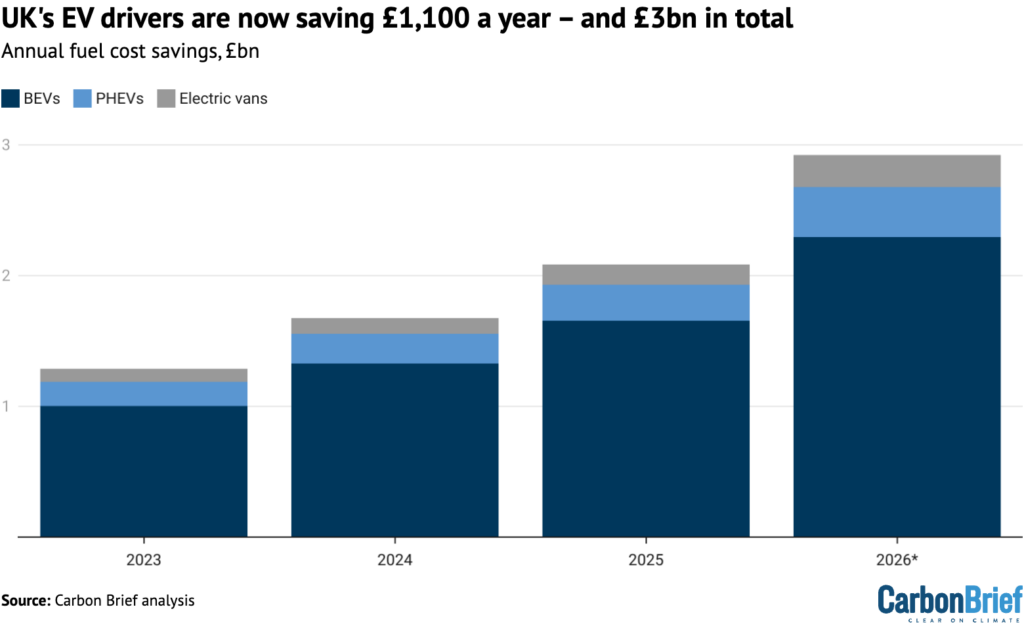
Chart showing UK EV drivers are now saving £1,100 a year – and £3bn in total.
The UK’s more than 2m battery electric vehicles (BEVs), 1m plug-in hybrids (PHEVs), and 100,000 electric vans already save drivers around £3bn annually. This equates to more than £1,100 per year in fuel savings per BEV driver. The analysis comes amid UK media reports that the government is considering weakening EV sales targets.
Spotlight
Oceans rising at UN climate talks
The state of the world’s oceans is tightly linked to climate change, and many delegates at UN climate talks are pushing for greater attention to ocean-related issues.
Oceans are often described as the planet’s “greatest ally” against climate change, absorbing around 30% of CO₂ emissions and most of the excess heat generated by them.
At the same time, they are central to climate solutions, including offshore wind expansion and the shipping sector’s transition to cleaner fuels. However, oceans are also increasingly a source of risk due to sea level rise, marine heatwaves, and ocean acidification.
This mix of roles has driven growing calls for stronger ocean integration within UN climate processes. During the Bonn negotiations (SB64), countries and civil society used an “ocean and climate change dialogue” to advance these discussions.
‘Elevate action’
Oceans were first formally included in UN climate outcomes in 2019, when COP25 requested an ongoing dialogue on how to strengthen mitigation and adaptation efforts related to oceans.
Since then, this dialogue has been held annually, but its political influence has remained limited.
COP31 is being co-led by Turkey and Australia, with Pacific island states playing a supporting role. Many of these nations identify as “large ocean states”, highlighting the ocean’s central role in their livelihoods and identities.
In Bonn, representatives from across the COP31 presidency expressed strong support. Australian minister and incoming COP31 “president of negotiations” Chris Bowen said:
“Australia, Turkey and the Pacific see an important opportunity to elevate ocean-based climate action.”
Strategies and finance
The two-day Bonn dialogue included panels, statements, and breakout discussions.
A key focus was how oceans are incorporated into national climate plans (NDCs). Around three-quarters of updated NDCs include ocean-related actions, with “blue carbon” ecosystems such as mangroves featuring prominently due to their dual role in carbon storage and coastal protection.
Delegates also discussed links with biodiversity negotiations and ocean finance, which currently accounts for less than 1% of global climate finance.
While talks continued in Bonn, officials also gathered in Mombasa, Kenya for the Our Ocean Conference. Carbon Brief associate editor Giuliana Viglione attended and will publish a full summary.
Developing countries stressed that many ocean-related commitments depend on increased financial support.
‘Political momentum’
With support from the COP31 presidency, participants expressed cautious optimism about advancing the agenda.
Charles Hamilton, advisor for the Bahamas representing the Alliance of Small Island States (AOSIS), said:
“A dialogue that just remains a dialogue is just more talk – no action.”
He emphasized that discussions must be translated into formal COP decisions and followed by implementation, particularly through financing mechanisms.
WWF-Brazil oceans lead Marina Corrêa highlighted the upcoming UN climate finance forum as an opportunity to increase pressure on ocean funding. She also called for a high-level ocean initiative to embed ocean issues more deeply into climate negotiations.
She concluded that there is a “really interesting opportunity” due to current political momentum.
Watch, read, listen
- ‘HOTTER THAN HELL’: BBC’s Rare Earth podcast examined extreme heat and lived experiences in the hottest regions.
- NOT BROKEN?: Ecologist John Drake published an essay (also in The Guardian) questioning narratives of ecosystem “breakdown”.
- ON COURSE: Climate journalist David Roberts interviewed UK minister Katie White on whether the UK will maintain its climate commitments.
Coming up
- 20–28 June: London Climate Action Week
- 21 June: Colombia presidential runoff
- 24 June: UK Climate Change Committee emissions progress report (2026)
Pick of the jobs
- Managing Editor – Africa, Mongabay (Global)
- Environment Reporter, Contexte (Brussels, €45,000–€60,000)
- Communications Director, Climate 200 (Australia)
- Energy Transition Correspondent, Energy Tracker Asia (South-East Asia, remote)